I have a brain fart that the medical community calls an Arnold Chiari Malformation. After decompression surgery in 2006, my brain is learning to coexist peacefully with my spinal cord in the cramped quarters of my spinal canal. With a real hole in my head, I am now free to continue the pursuit of life, liberty, and good coffee -- between headaches, nausea, dizziness, and seizures, of course!
Header from samulli Click here to see other entries or to play along.
In honor of America's Independence Day celebrations coming up this weekend, I wanted to celebrate the American Character with a list of interesting things about America and Americans. Here goes nothing!
1. 27% of Americans believe that we never landed on the moon. So how did Michael Jackson come up with the Moon Walk, then, huh?
2. Louisiana has 2,482 islands. Although with the BP oil rig disaster, they are disappearing.
3. There are about 500,000 detectable earthquakes in California each year. No wonder mine is the Rock & Roll state!
4. Jimmy Carter was the first US president to have been born in a hospital.
5. Our Pledge of Allegiance was written by a Socialist. Put that in your tea bag and steep it!
6. In the middle of the Mojave Desert, fifty miles from anywhere, is a phone booth. Why? Nobody remembers!
7. There are 140 towns and cities in America that have the word CHRISTMAS in their names.
8. Taft, California is home to the largest oil producing field in the lower 48 states.
9. Iced tea was served for the first time in 1904 at the St. Louis World's Fair. Now, it's a staple across the South.
10. The oldest capital city in the US is Santa Fe, New Mexico. It was founded in 1610.
11. John Adams and Thomas Jefferson both died on July 4, 1826, exactly 50 years to the day after the signing of the Declaration of Independence.
12. Until 1796, there was a US state named Franklin. Today we call it Tennessee.
13. Thomas Edison, inventor of the light bulb, was afraid of the dark.
Ok, this isn't really random, but since I didn't have the chance to answer some questions that Thom asked me a couple of days ago, I figured that I would tackle them today in this post.
Why is it only during certain times? Why isn't this done every day? The "sawm" means that, and I'm only going to use drinking here, can't be done between sunup and sundown so between then you can drink? Ramadan Kareem Means? and on the photo Mubarak is for?
Actually, Thom, we can fast at anytime, but fasting during Ramadan is mandatory for everyone who is physically able. Ramadan is the month in which the Qur'an, the Muslims' holy book, was first revealed, so it's a really special and important time.
In spite of the lunacy that we see on the news from some Muslims, our religion actually cautions us to maintain a middle of the road stand and to avoid extremism of all kinds. For example, a story relates that when a man visited his brother's household, he noticed that his brother's wife appeared neglected. When Salman asked his sister-in-law what was wrong, she replied that her husband, Abu Darda, had taken up fasting every day and praying all night. As a result of his well-meaning religious zealotry, Abu Darda was neglecting his wife and family. No Muslim is allowed to go such lengths as to neglect his worldly responsibilities for religious "extra credit," so to speak. Salman convinced his brother to stop fasting every day and praying all night by reminding him that this family had rights on him that he had an obligation to fulfill. When Salman related the story to Prophet Muhammad, he approved of the way the situation had been handled by the brother and cautioned all Muslims to avoid such extremism.
To understand the no eating, drinking, etc. rule a bit better, here's a nifty link to a PDF file showing the actual fasting times for the month. The fast begins about 30 minutes before the Fajr prayer (the first prayer of the day) which, for today, was at 4:52 AM; the fast ends with the fourth prayer of the day, Maghrib, which today comes at 7:26 PM. Total fasting time for the day? Rounding up or down as needed for convenience, it looks like this: start at 4:30 AM and end at 7:30 PM for a total of 15 hours. During these 15 hours, the no food, drink, etc. rule applies. In the hours after the Maghrib prayer until 30 minutes before the next Fajr (dawn) prayer comes, we can eat, drink, and generally be merry -- oh, and sleep a little bit so that we can function the next day when we can't eat or drink again, LOL.
Random Thought #2
The pro-op visit with Dr. Oz went well, and now I am just waiting for the hospital to call and let me know what time I need to show up at the hospital on Thursday morning. I've already done my Mostly Wordless Wednesday post with most of the details, so you'll have to sit on pins and needles (lookie there -- an idiom for Jentjie!) until it launches automatically at 12:01 AM on 8-26. Ooooh, I like being mean!
Random Thought #3
Why is it that just when you express gratitude for an easy summer, the weather changes and it turns hot? This is what the Amazing Egyptian Dude calls giving myself the "evil eye." I swear, just a couple of days ago I was saying how glad I was that we had had such a pleasant summer, how the weather had been much cooler than normal, and how we had saved a considerable amount of money because I hadn't needed to run the a/c very often. And then . . .
I start hearing the lyrics to an old Elvis song:
Lord almighty, I feel my temperature rising Higher higher Its burning through to my soul
[. . .]
Ooh, ooh, ooh, I feel my temperature rising Help me, Im flaming I must be a hundred and nine Burning, burning, burning And nothing can cool me I just might turn into smoke But I feel fine
Except that I don't feel fine -- I feel hot! And I feel sorry for the Amazing Egyptian Dude who is fasting and hanging out in our warehouses, where it is always at least 10 degrees hotter inside than out.
Lesson learned on this one? Keep my big mouth shut and avoid those evil eyes!
Click the banner to play along or to see other entries.
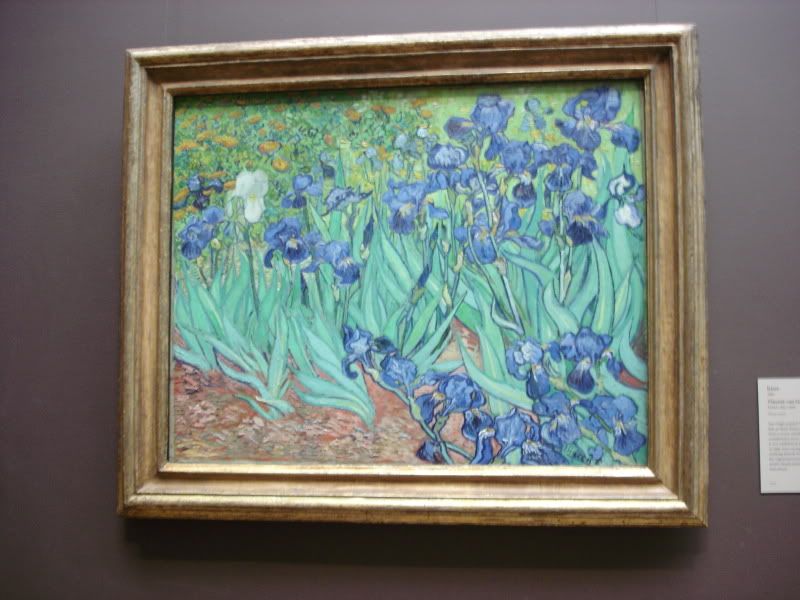
Irises Vincent Van Gogh, 1889 Click on the photo to enlarge.
Did you know . . .
that Irises originally sold for 300 francs but was acquired by The Getty in 1987 for $53.2 million?
in the last year of his life, Van Gogh created 130 paintings, one of which was Irises, while he was in an asylum?
there are no known drawings for this painting and that Vincent himself said that he considered it a study?
art critics say that Irises reflects Vincent's angst and mental illness in the lone white iris that is surrounded by the dozens of blue ones? If you look closely, you might see the painting as I do -- the blue irises seem to be "looking" in the direction of the lonely and isolated white flower, adding to the feeling of Otherness.
I have been lucky enough to have seen several of Van Gogh's most famous creations, including Starry Night. The intimate setting of The Getty makes it possible for visitors to see Irises "up close and personal," close enough that the passion, depth, and artistry of the brush strokes are unbelievably clear. Starry Night has a similar quality but where it is a harried, passionate swirl of emotions, the passion in the brush strokes of Irises is more carefully controlled.
No matter how many times I see this piece, my eye is immediately drawn to the left side of the canvas where I am struck with the sadness of a lonely and unique white blob that stands out in a field of blue sameness. Like Van Gogh, that one iris is the same yet different, alone yet surrounded by others. In a single flower, Van Gogh expressed what it feels like to be the Other -- to be Othello, a black convert from Islam to Christianity, in the world of the race, class, and religious conscious Venetians; to be Shylock, a Jew whose Old Testament understanding of justice is anathema to the New Testament "quality of mercy" Venetians; to be Vincent Van Gogh, a passionate artist with extraordinary vision, in a world of ordinary uniformity.
Where do dirty glasses come from? I am a coffee drinker. Period. Aside from the occasional glass of iced tea, I drink coffee. Coffee requires a cup -- just one cup. I start with a clean one every morning and as I finish one cup of coffee and get ready to make another, I wash the same cup that I began the day with. The Amazing Egyptian Dude drinks a cup of coffee in the morning before he leaves for the office, and a glass of hot tea (Egyptians drink hot tea in glasses instead of cups) in the evening before he goes to bed. If he has iced tea, too, then he has used a total of 2 glasses and 1 cup. Add to this my 1 cup, and I should be washing 4 drinking vessels daily. So how come my sink is perpetually filled with dirty glasses? Where do they come from?
Ok, we do have a guest now. And the past three or four weekends, Iman, Magdy, and Basma have been here. But still, that doesn't explain how a well-stocked cupboard can go bare in a matter of minutes and my sink fill up in record time! Unless . . .
. . . is it possible that everyone but me is using a different glass or cup each time they get a drink? And if they are, why is that I'm the only one washing all of them?
Who said picnics are outdoor events? On Saturday, we went to see the opening performance of the Long Beach Shakespeare Company's production of Julius Caesar. When we've attended performances in the past, they've always been held in a park where we could bring along a picnic. So when I invited the usual group of suspects -- er, friends -- to join us, I suggested that we just continue the established pattern of everyone bringing a dish for all to share. I fried about 40 pieces of chicken, made a gigantic bowl of macaroni salad, and the Amazing Egyptian Dude filled the ice chest with water, soda, and ice.
Imagine my surprise when, as we were approaching the freeway exit, I get a call from Diana, the 4th grade BFF who joined us for the first time this year, telling me that the address from the company's website was actually a furniture building of some sort. What?! Sure enough, the performance was being held indoors at an empty furniture expo that the city of Long Beach owns. Despite the change of venue, our picnic was still on.
Although the acoustics in the building left a lot to be desired, the performance was quite good. Each member of the richly diverse cast performed his or her heart out and played as if to a full house. The dance at the Lupercalia was a bit unusual because the ancient Roman festival was celebrated to honor shepherds and this production's director turned it into a visual orgy better fitting the Bacchanalia. It is strange turns in the interpretation of the plays, like this one, that make me genuinely enjoy watching performances by local theater companies.
During the intermission, the company's Co-Artistic Director, Denis McCourt, introduced himself to us and engaged us in a friendly conversation. A very personable fellow, Denis was genuinely interested in feedback from the audience as well as ideas for future productions. It was from Denis that we learned why the venue had changed. The Furniture Expo is an empty building that belongs to the city of Long Beach. Someone, somewhere, somehow was able to convince the city to allow the building to be used for a Center for the Arts and with the city's agreement, the company is allowed to use the facility at no cost. For small theater groups such as the Long Beach Shakespeare Company, find a free venue is a godsend.
In these trying economic times, families look for things to do that cost very little. Check your city to see if they have a theater company and if the do, go see a play! It is very often free or very low cost if a fee is involved.
Here's wishing everyone the start of a great week!
Have you ever wondered what happened to the 56 men who signed the Declaration of Independence?
Five were captured by the British as traitors, tortured before they died.
Twelve had their homes ransacked and burned.
Two lost their sons serving in the Revolutionary Army; another had two sons captured.
Nine of the 56 fought and died from wounds or hardships of the Revolutionary War.
They signed and they pledged their lives, their fortunes, and their sacred honor.
What kind of men were they?
Twenty-four were lawyers and jurists.
Eleven were merchants, nine were farmers and large plantation owners; men of means, well educated, but they signed the Declaration of Independence knowing full well that the penalty would be death if they were captured.
Carter Braxton of Virginia, a wealthy planter and trader, saw his ships swept from the seas by the British Navy. He sold his home and properties to pay his debts, and died in rags.
Thomas McKeam was so hounded by the British that he was forced to move his family almost constantly. He served in the Congress without pay, and his family was kept in hiding. His possessions were taken from him, and poverty was his reward.
Vandals or soldiers looted the properties of Dillery, Hall, Clymer, Walton,Gwinnett, Heyward, Ruttledge, and Middleton.
At the battle of Yorktown , Thomas Nelson Jr., noted that the British General Cornwallis had taken over the Nelson home for his headquarters. He quietly urged General George Washington to open fire. The home was destroyed, and Nelson died bankrupt.
Francis Lewis had his home and properties destroyed. The enemy jailed his wife, and she died within a few months.
John Hart was driven from his wife 's bed side as she was dying. Their 13 children fled for their lives. His fields and his gristmill were laid to waste. For more than a year he lived in forests and caves, returning home to find his wife dead and his children vanished.
Some of us take these liberties so much for granted, but we shouldn't.
So, take a few minutes while enjoying your 4th of July holiday and silently thank these patriots. It's not much to ask for the price they paid.
Today is the official birthday of the United States of America. It's a day of celebration all over the country. Barbeques, fireworks displays, patriotic music, and displays of stars and stripes in red, white, and blue will appear from sea to shining sea throughout the day. The Amazing Egyptian Dude and I wish you all a Fabulous Fourth!
Fourth of July Fun Quiz
I'll post the answers after Disneyland's fireworks show tonight.
1. Who signed the Declaration of Independence first?
2. Which country was America's first foreign ally?
3. Two former presidents both died on July 4, 1826. Do you know who they are?
4. This American author, fond of the color red and the first letter of the alphabet, was born on July 4, 1804. Who is he?
4. Only one American president was born on July 4. Do you know which one?
5. Which state has the oldest continuous July 4th celebration?
Header from samulli Click here to see other entries or to play along.
The tapestry of American patriotic music is as rich and varied as her people. Hymns, marches, national songs, poetry, military themes, and music from the theater, television, and radio combine to reflect the pride and hope embodied in the American Experience. With the celebration of our independence just two days away, my list is about American Patriotic Music. I hope that you enjoy it as much as I enjoyed researching and writing it.
1. America the Beautiful Katharine Lee Bates wrote the lyrics for "America the Beautiful" while on a lecture trip to Colorado in 1893 after being inspired by a trek up Pike's Peak in a prairie wagon. Originally sung to any tune that fit the lyrics -- "Auld Lang Syne" was the most popular, "America the Beautiful" didn't have its own melody until 1882 when Samuel Augustus Ward, a New Jersey church organist, composed one for it. Thereafter, the song has been sung the way we recognize it now.
2. My Country 'Tis of Thee While we know that Reverend Samuel Francis Smith wrote the lyrics for this song in 1831, the mystery surrounding the composition of its melody remains unsolved. The tune's first appearance in a verifiable form is in the 1744 tune book, Thesaurus Musicus, printed in England. It has been used mostly for songs honoring kings and became the national anthem in 6 countries before making its way across the ocean to America.
3. Battle Hymn of the Republic Julia Ward Howe, a staunch abolitionist, rewrote the lyrics to a very popular song among the Union troops during the Civil War. The soldiers called the song "John Brown's Body" in honor of John Brown, the abolitionist killed at Harpers Ferry. But after visiting Washington, D.C. with her husband in 1861 and hearing Union soldiers marching to the tune, Julia determined to write lyrics that better suited the majesty of the music. The end result is the song that we now know and love.
4. When Johnny Comes Marching Home Again The story of one of the most popular songs of the American Civil War is also the story of the Irish immigrant who wrote it. John Philip Sousa considered Patrick Sarsfield Gilmore, an 1848 Irish immigrant and author of the song, "The Father of the American Band." In 1861, Gilmore's band was attached to the 24th Massachusetts Infantry where they served as both musicians and stretcher bearers in some of the most significant Civil War battles including Bull Run, Antietam, Chancellorsville, Gettysburg, and Richmond. In 1863, when he was posted to occupied New Orleans, Louisiana, Gilmore composed "When Johnny Comes Marching Home." The song became popular with northerners and southerners alike.
5. You're a Grand Old Flag I love the story of this song! Written for his stage musical, George Washington, Jr. in 1906, George M. Cohan's inspiration came from a random meeting he had had with a Civil War veteran who, like my great-great grandfather, had fought at Gettysburg. Cohan noticed that the old man was holding a carefully folded but ragged old flag and when the old man saw Cohan looking at it, he said, "She's a grand old rag." That old man's comment about a cherished battle-worn flag became the original title of the song; however, when people objected to the flag being called a "rag," he changed the word to "flag." Maybe if Cohan had explained why he titled the song the way he did, people would have reacted more positively to it because its meaning with the original title and lyric is much more powerful!
6. Hail to the Chief Did you know that this song, which plays with every formal entrance made by an American president, actually has its origins in a poem written by a Scotsman? Sir Walter Scott's poem, "The Lady of the Lake," tells the story of a Highlands Scottish clan that loses its heritage and land to an imperalist invader (the Brits): "Hail to the Chief who in triumph advances!" The song first came to be associated with presidents when, on February 22, 1815, it was played honor both the deceased George Washington and the end of the War of 1812.
7. Marine's Hymn The tune for this song actually came from Jacques Offenbach's comic opera Genevieve de Brabant, first staged in 1859. Nobody knows who added the lyrics or when, but at least one verse has been traced to Colonel Henry C. Davis who wrote it during the early part of the twentieth century.
8. Stars and Stripes Forever (check out the video for this one!) John Philip Sousa was the greatest musical star of his era, combining the charisma and popularity of Leonard Bernstein and The Beatles. He wrote "Stars and Stripes Forever" in 1896, while grieving over the death of his manager. For 25 years, Sousa's band played this song at the end of every concert. "The Stars and Stripes Forever" was declared the National March of the United States in 1987.
9. Yankee Doodle This is one of America's oldest, and most enduring, marching songs. It was written several years before the American Revolution, but like so many songs of old, its origins aren't clear. What we do know about it is that the song isn't really as patriotic as it seems: it is a British parody of the early American militiamen. "Yankee" comes from "Nankey," a word from a well-known not-so-nice song about Oliver Cromwell that later became the name for American colonists; "Doodle" means a fool or simpleton; "Dandy" is a word used to describe a gentleman of artificial manners, dress, and hairstyle -- in other words, a fake. Put these three words together, Yankee Doodle Dandy, and you have a foolish American colonist who puts on airs. At the battles of Lexington and Concord, the British troops sang the song to make fun of the rag-tag American militiamen.
10. This Land Is Your Land Woody Guthrie, America's most influential folk musician, wrote "This Land Is Your Land" in 1940 after becoming annoyed with Irving Berlin's song, "God Bless America," which Guthrie thought glossed over the lop-sided distribution of land and wealth that he was observing during the Great Depression and had experienced as a child growing up in Oklahoma. Guthrie's observations accurately reflected the fact that, even in the depths of the Depression, nearly 20 percent of the nation's wealth rested with one percent of its population. Guthrie's personal and musical styles were deeply influenced by his childhood in rural Oklahoma during the Great Depression years, which led him to a hobo life-style, a powerful dislike of greed, and a deep appreciation for the diversity of America's everyday folk.
11. God Bless America Shortly after becoming an American citizen in 1918, Irving Berlin, already a highly successful popular lyricist and composer, was inducted and stationed at Camp Upton in Yaphank, Long Island, New York. While stationed there, Berlin convinced his commanding officers to allow him to write a musical comedy that could be used to raise both funds and troop morale, and the original version of this song was part of this production. But after he heard the song, Berlin decided that it was too serious for a comedy and tucked it away for 25 years. On November 10, 1938, contralto Kate Smith introduced the song to America on her CBS radio show that was broadcast from the New York World's Fair. Timing is everything; the song became an instant hit. Berlin generously signed over his royalty money from the song to charity, and the revenues went to the Boy Scouts and the Girl Scouts of America.
12. God Bless the U.S.A. Lee Greenwood, a country music artist, wrote "God Bless the USA" in 1983 as a patriotic song about his country. When it was originally released, it didn't top the charts; however, it quickly became Greenwood's signature song. When the Amazing Egyptian Dude was sworn in as a U.S. Citizen, this is the song that played in accompaniment to a video showing scenes of what it means to an American. We already knew the song because we have been fans of Greenwood's music for quite some time, so the AED was thrilled when the song blared out from the loudspeakers at the Los Angeles Convention Center on the day that he officially became an American in 1986. If you've never been lucky enough to witness the swearing in of a new American citizen, check out this video; the song & video we saw is at 8:05. I guarantee goosebumps!
13. The Star Spangled Banner Francis Scott Key put new words to an old song when he wrote what would become the national anthem of the United States of America. In the mid-1760s, a London society of amateur musicians, the Anacreontic Society, commissioned a young church musician, John Stafford Smith, to compose music for material that its president, Ralph Tomlinson, had written. The result was a song called "Anacreon in Heav'n." Its metric difficulty was meant to be the vehicle through which the group's best bariton singer could display his virtuosity and vocal range. Its musical complexity has been compared to the famous "Toreador Song" in Bizet's opera Carmen. The tune appeared in North America before the end of the 18th century where the lyrics were rewritten to include references to Jefferson, Adams, and Liberty. Francis Scott Key was fascinated by the song's unique metrical structure, not found in any other song of the period. That explains why it's so difficult for the average person to sing!
So, how did it become our national anthem? While detained aboard a British ship during the bombardment of Ft. McHenry on September 14, 1814, Francis Scott Key witnessed at dawn the failure of the British attempt to take Baltimore. He used this experience to write a poem that asked the question "Oh, say does that Star-Spangled Banner yet wave?" or in modern American English, "Hey, Dude, is that flag still flying?"
Almost immediately Key's poem was published and set to the tune of the "Anacreontic Song." The Secretary of the Navy, on July 26, 1889, designated "The Star Spangled Banner" as the official tune to be played whenever the flag was raised, and Woodrow Wilson chose the song to be played whenever a national anthem was appropriate because we didn't have one yet. It wasn't until March 3, 1931, that the song was made our official anthem by President Herbert Hoover.
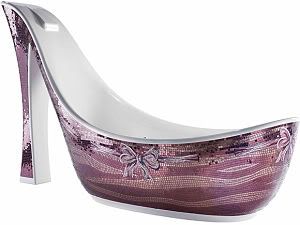
If you're in the market for a new bathtub, you might want to consider one of these Italian models from SICIS, an art mosaic company:
The "Audrey" is decorated with tiles and is available in pink, blue, black, and white. Starting at just $17,000, the tubs can be custom made to suit your taste.
This surely puts a whole new spin on the Old Lady in the Shoe tale, don't you think?
June 14th is the day set aside to honor the flag of the United States of America and all that it represents. I thought it would be fun to share some facts and trivia about the U.S. flag today.
Did you know. . .
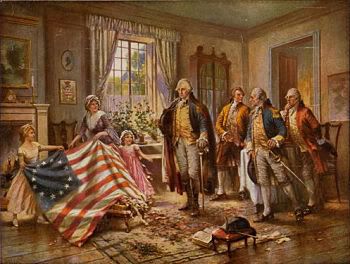
that the story about Betsy Ross sewing the first official American flag is mostly myth?
that Robert Peary cut a flag into pieces and scattered them around the North Pole?
that the only time it is appropriate to fly the flag upside down is to signal an emergency?
that an expert in the history of flags is called a vexillologist?
that the phrase, "one nation under God," was added to the Pledge of Allegiance in 1954?
that the original Pledge of Allegiance, written in 1892 by Francis Bellamy, a Baptist minister and Christian Socialist, read like this: "I pledge allegiance to my Flag and the Republic for which it stands, one nation, indivisible, with liberty and justice for all"? Believing that equality, liberty, and justice were the cornerstones of America, Bellamy wanted to add "equality" to his pledge; however, the first official ceremony in which his pledge would be used was a public school program for the quadricentennial celebration of Columbus Day, and since Bellamy knew that the state superintendents of education were against equality for women and African Americans, he left the word out of the pledge.
that the United States did not even have a standardized flag until 1912?
that it takes 64 pieces of fabric to make an American flag, more than any other flag in the world?
that the American flag has changed designs more than any other flag in the world? To date, there have been 27 different versions!
that in 1912, President William H. Taft (who happens to be one of my ancestors, by the way!) standardized the arrangement of the stars into rows?
that the first states to require, by law, schools to fly the flag daily were North Dakota and New Jersey in 1890?
that the first official Flag Day was celebrated in Philadelphia in 1893?
that 10-year-old Billy Gobitas' 1935 letter to the school board of Minersville, Pennsylvania, in which he wrote, "I do not salute the flag because I promised to do the will of God," sparked one of several constitutional battles over the states' right to demand a specific type of respect for national symbols when doing so violated an individual's freedom of religion. Billy Gorbitas was a Jehovah's Witness. In 1943, the Supreme Court held that the federal government has no right to compel citizens to salute the flag or recite the pledge of allegiance.
You're a Grand Old Flag George M. Cohan
You're a grand old flag, You're a high flying flag And forever in peace may you wave. You're the emblem of The land I love. The home of the free and the brave. Ev'ry heart beats true 'neath the Red, White and Blue, Where there's never a boast or brag. Should auld acquaintance be forgot, Keep your eye on the grand old flag.
I stumbled across your old picture today I could barely breathe The moment stopped me cold Grabbed me like a thief I dialed your number But you wouldn't be there I knew the whole time But it's still not fair I just wanted to hear your voice I just needed to hear your voice
What do I do with all I need to say? So much I want to tell you every day Oh it breaks my heart I cry these tears in the dark I write these letters to you But they get lost in the blue 'Cause there's no address in the stars
Now I'm driving through the pitch black dark I'm screaming at the sky cause it hurts so bad Everybody tells me all I need is time Then the morning rolls in and it hits me again And that ain't nothing but a lie
What do I do with all I need to say? So much I want to tell you every day Oh it breaks my heart I cry these tears in the dark I write these letters to you but they get lost in the blue 'Cause there's no address in the stars
Without you here with me I don't know what to do I'd give anything just to talk to you Oh it breaks my heart Oh it breaks my heart All I can do is write these letters to you But there's no address in the stars











 Posts
Posts